




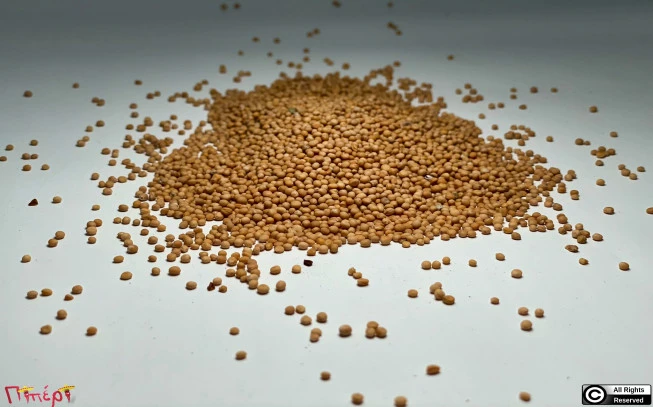
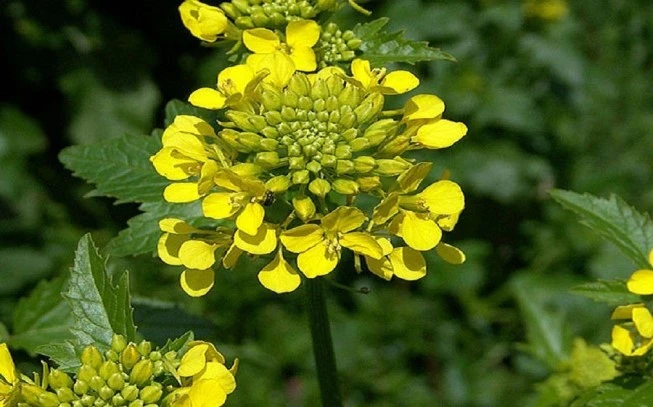
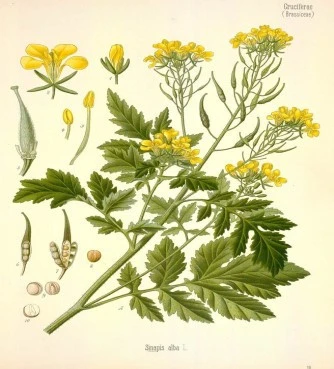
The seeds of the most widespread spice in the world.
BRAIN FUNCTIONS
CONSTIPATION
ORAL HEALTH
PAINS
RESPIRATORY
The history of mustard seed begins around 3000 BC. in India, where it refers to Sanskrit writings of that time.
In ancient Greece in the 6th century BC. The mathematician Pythagoras recommended mustard as a remedy for scorpion stings, while a century later, Hippocrates used it in poultices and medicines.
It was cultivated in medieval Europe for medicinal reasons and as a food preservative because it stops the action of bacteria.
Mustard is also made from mustard.
The two main types of mustard are yellow and black.
It is cultivated all over the world because it has multiple uses.
It grows in cold climates, mainly in the areas of Northern Canada, Dakota where the quality of the produced mustard seed is evaluated as the best of its kind. The following are the quality productions of Eastern European countries (Romania, Czech Republic, Poland).
There are two mustard production schools, German and French (Dijon).
Their difference is basic and mainly concerns the processing of the main raw material, mustard seed.
The French method of production uses only the kernel (seed) of the seed, in contrast to the German method which does not process the seed at all and uses it whole.
Yellow is commonly used in the kitchen and black in the pharmaceutical industry.
It tastes first sweet and then spicy.
We use whole seeds with pickles, pickles, fish marinades and even as a seasoning for cold cuts and cooked vegetables.
Mustard powder is used plain to marinate meat or as a base to make the well-known mustard.
Therapeutic:
With gargling for a sore throat.
It is also highly recommended for chronic constipation.
It is valuable in a congestion of the brain as well as in rheumatism and uterine (foot baths).
We chew some yellow mustard seeds on a toothache.
1-2 seeds of yellow mustard powder with honey in the morning on an empty stomach clears the voice.
Black seeds are stimulants, diuretics and when applied they are useful in pneumonia, bronchitis, pleurisy, rheumatism, neuralgia to create local hyperemia. (We hit them in a mortar and apply externally and never directly on the skin, always inside a cloth).
If we throw crushed seeds in hot water we have a good foot bath that relieves us from colds and headaches.
Also mixed with honey they are applied as an ointment on bruises and they disappear.
Seed flour is an excellent antiseptic and deodorant.
Boiled mustard seed poultice relieves all types of rheumatism. (If you want in all external applications we can add an egg white to avoid irritation).
Properties : Mustard has a stimulating effect on all body functions and gives a sense of well-being.
Black with a spicy taste is therapeutic only for external use.
Mustard has heating and antibiotic properties.
Infusion : yellow seeds for chronic bronchitis and rheumatism.
Active ingredients : Sinalbin, mustard acid, myrosin, Essential oil, large amount of vitamin A, potassium, calcium, phosphorus, sodium and magnesium.
How to use : Infusion (white-yellow seeds), external use, poultice, foot baths (black seeds.)
 Filters
Is expected
Code: 173
Price: 2,00€ / 100 grams
Available
Code: 495
Price: 2,50€ / 250 grams
Available
Code: 771
Price: 12,00€ / 1,000 grams
Available
Code: 2017444427254
Price: 2,25€ / 50 grams
Available
Code: 689
Price: 5,00€ / 50 grams
Available
Code: 372
Price: 25,00€ / 50 grams
Available
Code: 153
Price: 1,75€ / 50 grams

‹
›