




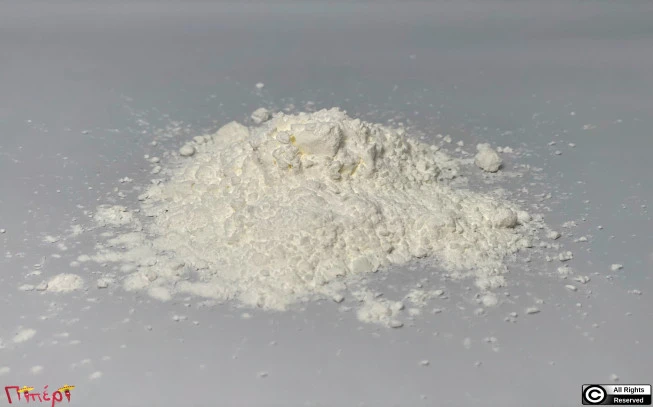
Baking powder is the evolution of soda in our kitchen.
It is based on sodium carbonate, described in the Food Additives Code as E 500. Produced from seawater or salt, it is a natural mineral and is used as an acidity regulator, alkali and as a thickening agent. It is safe for health, so no side effects have been reported and no daily intake limit has been set.
Baking powder or artificial yeast is an advanced version of baking soda, as it contains the acid needed for simple soda to have a leavening ability.
It also contains minimal starch that absorbs moisture.
We use it to puff (raise) the dough, especially the sweets and it is, I would say, a "chemical yeast".
Baking powder was adopted, almost eliminating the soda of our grandmothers, because it ensures, much easier, uniform swelling and fluffy texture in sweets, cakes and various other pastries.
It has the advantage that it does not need to be dissolved in liquid, we can add it directly to the flour.
This is why it is recommended in recipes that do not contain enough liquid ingredients.
But its action starts from the moment it comes in contact with the heat of the oven.
This is the explanation of the "order" not to open and close our oven often, we read some recipes.
Little secrets
Baking powder may be easy to use, but it is also weaker than baking soda. So, if you want to replace baking soda with baking powder, calculate that for the same dough you will need almost three times the amount.
When using baking soda instead of yeast in a dough, calculate that 1 tablespoon of baking soda is equivalent to one sachet of yeast. If a pinch of salt is suggested, you should skip it because bicarbonate of soda contains salt.
In case a recipe calls for self-raising flour (flour) and you have a common flour for all uses, you can use it by adding for every 500 grams of flour 1.5 teaspoon of baking soda along with 1 tablespoon lemon juice or 3.5 teaspoons of baking powder.
 Filters
‹
›